Current Research Projects
“Story and knowing have been tightly bound together as a legitimate form of understanding since time immemorial.”
― Margaret Kovach, Indigenous Methodologies: Characteristics, Conversations, and Contexts (2007).
Dr. Howell’s research falls into three broad stands; The first is Indigenous-led community based research where the research questions and methodologies, process, and outputs are led by and co-developed with the community. Her work with the Survivirs of Kitigan Zibi is an example of this. Her second area of research is the impacts of policies on educational practises and pedagogies, such as the impacts of mandatory Indigenous content courses. Finally, the third area of research is transformative reimagining practises in teacher education, such as the work she is doing with Dr. Donald on Reimaging teacher education and with Dr. Radford on the urban communities cohort.
Please see below for current projects that Dr. Howell is involved in as a Principle Investigator, co-investigator, and research associate.
-
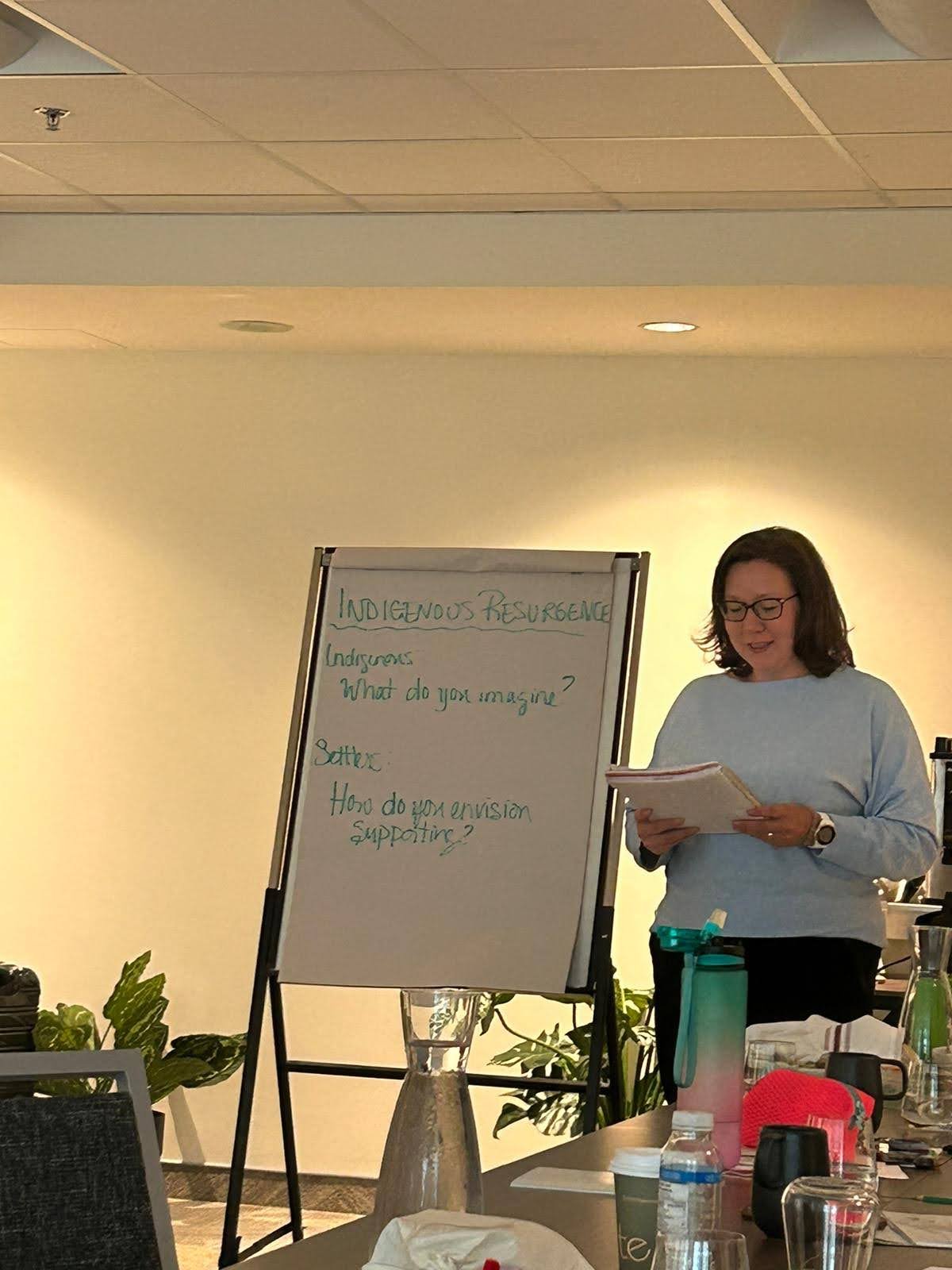
Resurgent Foundation(s) within Settler Colonial Walls: Indigenous-Led Inquiry of Mandatory Indigenous Courses.
This project, led by PI Dr. Tricia McGuire-Adams, with co-investigators Dr. Cindy Gaudet, Ms. Jana-Rae Yerxa, and Dr. Lisa Howell seeks to understand how mandatory courses contribute to structural change and decolonial solidarity movements. We have found that while the courses serve to educate and raise awareness among Settler students, much of the labour falls on Indigenous professors to teach the courses that are often “settler colonialism 101”. Moreover, if the courses continue to stay at the “101” level, structural change and decolonial solidarity movements will not occur .
Look out for the publication of a special issue on our research in AlterNative, an International journal of Indigenous Peoples.
-
Reimaging Teacher Education with Indigenous Wisdom Traditions
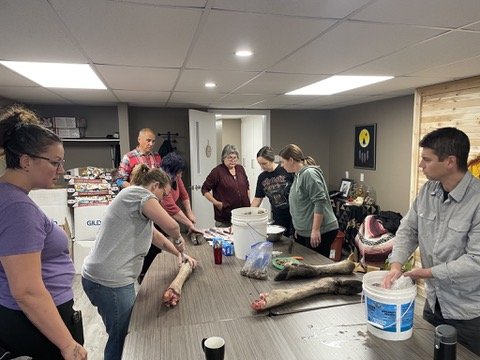
One of my current research collaborations is with Dr. Dwayne Donald, who is a CRC Tier 1 at the University of Alberta. The objectives of this research are to collaborate with educators to conceptualize unlearning colonialism as a recursive pedagogical process. We do this by facilitating opportunities for educators to learn from Indigenous wisdom insights and deliberate together on how best to enact these insights in their teaching practices. We work with 12 teachers from the Western Quebec School board, in partnership with Kitigan Zibi Anishinabeg, 4 times a year until 2028. Over the past three years, we have learned from community members, sat and listened in circles with Elders, paddled along the Desert river, learned to skin moose legs and beavers, learned some of the Anishinaabemowin language, learned about the history of Kitigan Zibi, and participated in ceremony. We will continue to collaborate together in this way to understand how substantive time, immersive experiences, and learning from Indigenous peoples supports unlearning colonialism. We then hope to translate how the unlearning process can be applied to practice.
Dwayne and I have a new chapter out that speaks to this work: Howell, L., & Donald, D. (2026). Moose legs and countermaps: Reimagining teacher education with Indigenous wisdom traditions. In A. Eizadirad, E. Kilinc, & J. M. Straub (Eds.), Research as Activism in Education: Community-Oriented Perspectives (pp. 263–286).
-

Beyond the Cohort: Lessons and Legacies from the Urban Communities Experience
Co-PI’s: Dr. Lisa Howell and Dr. Linda Radford. Over ten years ago, the Urban Communities Cohort (UCC) was established at the University of Ottawa Faculty of Education to ensure teacher candidates were better prepared to work within urban priority schools. Our research seeks to understand the experiences of UCC members, and how it informed their experiences in teacher education and their current pedagogical practices as teachers.
You can view the presentation we gave at the Canadian Society for Studies in Education Congress in Winnipeg in June here.
-
Community-led Research in Kitigan Zibi
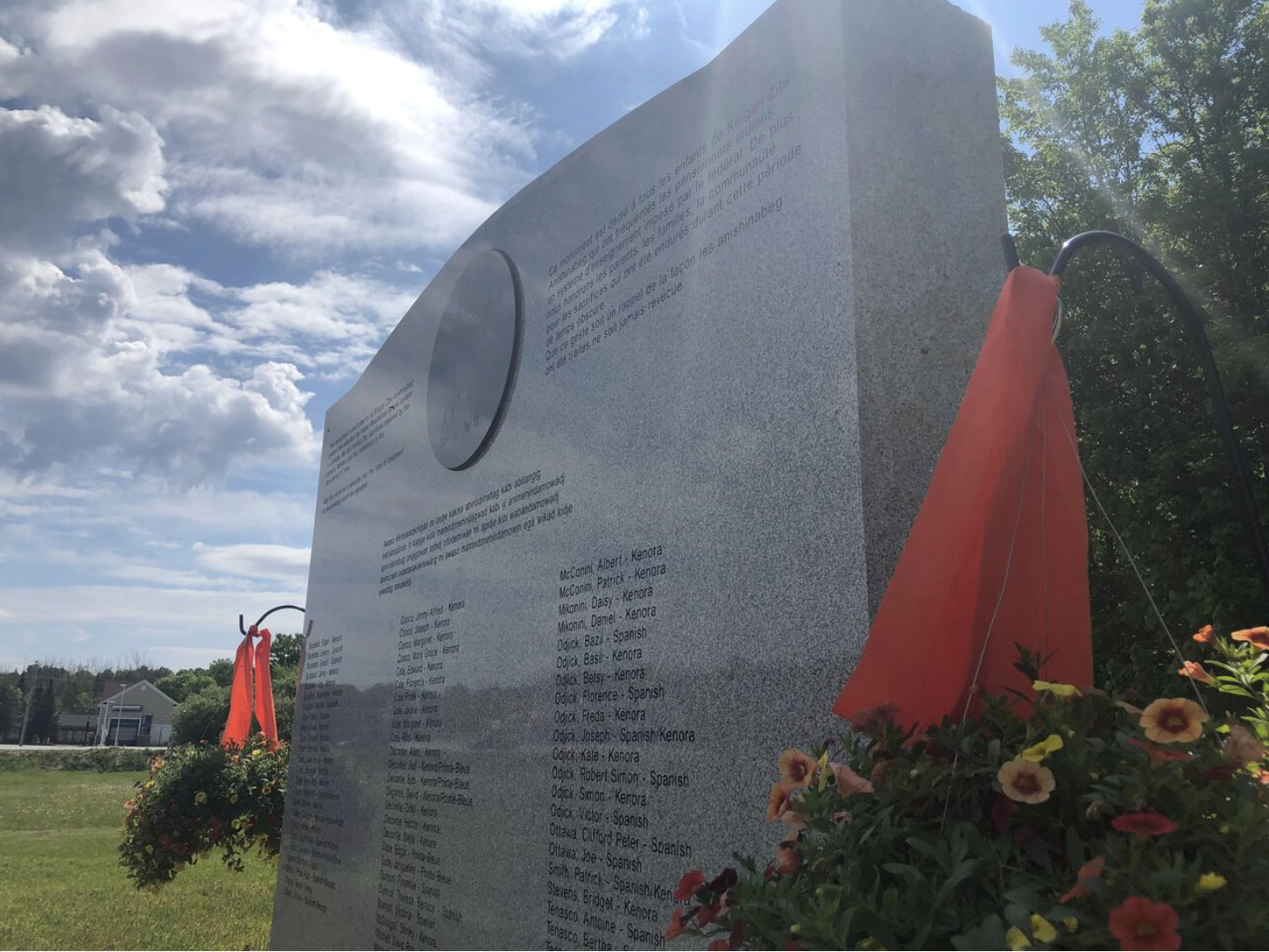
For a period that spanned nearly nine decades, children were forcibly removed by the Canadian state from their families, culture, land, and community of Kitigan Zibi Annishinabeg. These children, some as young as three years old, were put onto trains and taken to Indian residential schools, including St. Mary’s in Kenora Ontario, located 1,837 kilometres away from their home. Many survivors urgently want to share, document, and record their lived experiences so that they are not forgotten and so others can learn from their experiences and wisdoms. This Community-led research will uplift the survivors with an opportunity to participate in research that takes place in their community, for their community, with a lasting impact for future generations.
-
Nunavik Sivunitsavut: Where Our Future Gathers: Voices for Nunavik"
Nunavik Sivunitsavut (NS) is an Inuit-led Tremplin DEC program designed to support Nunavimmiut students through culturally grounded post-secondary preparation. Unique to Québec's CEGEP system, Tremplin DEC programs allow students to strengthen academic skills, complete prerequisites, and explore fields of study before entering a regular college program. Delivered in partnership with John Abbott College and supported by Kativik Ilisarniliriniq (KI), NS offers college-level courses in Inuit history, governance, language, literature, and culture while supporting students' transition to further education and leadership roles in Nunavik. As NS approaches its tenth anniversary, this moment offers a timely opportunity to reflect on what has emerged in order to inform future program development. While research on the Ottawa-based Nunavut Sivuniksavut has documented meaningful outcomes related to Inuit identity, cohort learning, and educational persistence (Hanson, 2003; Rodon et al., 2015), no research has examined the Québec program on whether NS is meeting its stated goals, including fostering cultural pride, strengthening leadership, and deepening students' knowledge of Inuit history, politics, and Inuktitut (Nunavik Sivunitsavut, 2026). Therefore, this research project asks the following question: How does participation in Nunavik Sivunitsavut relate to Nunavimmiut students' post-secondary trajectories, leadership capacity, Inuk identity, and connections to the broader Nunavik community? By documenting the experiences of current and former students, the project will provide Inuit educators, communities, and regional organizations with evidence to strengthen program development.